Apr
17
Introducing RTÉjr

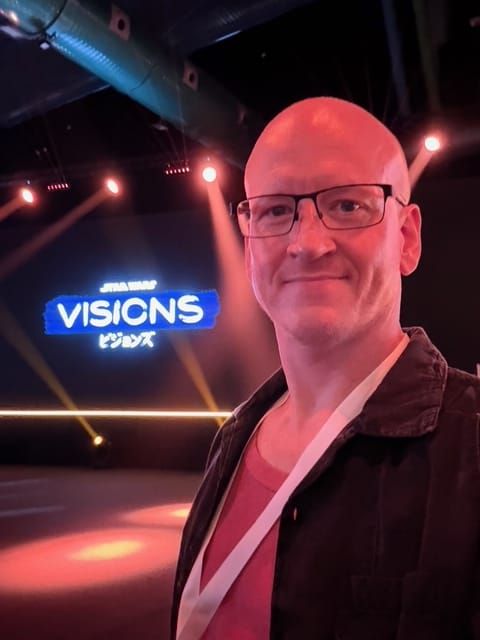
On Monday, I attended the launch of RTÉjr, Ireland’s new dedicated children’s channel. Broadcasting twelve hours a day, the channel brings content directly to Irish children, expanding what was once a block on RTÉ2 into a full channel sitting along with all the other children’s channels on Sky, UPC and Saorview. Now I should point out that I have five shows currently airing on the channel so it’s likely I would say some pleasant things about it – I have been referring to the channel as my ‘showreel’, after all. But there is more to RTÉjr than just being a place to catch some of my shows.

RTÉjr is a big positive step for all Irish children. An important step. Here is why -

It is a dedicated children’s channel focusing on children aged seven and under. I have previously expressed my appreciation for dedicated children’s channels on this site. I feel they give parents more control, lessen the risk of inappropriate content and they simply make it easier to pick and choose what our children watch.

It is a channel focusing on delivering specifically to Irish children. Local content is so important to children. Each country has its own culture, its own ways of looking at the world. That unique point of view should be represented in the shows kids watch. Anyone in children’s content will know just how difficult that is to achieve – most shows need to be sold all over the world to stand a chance of breaking even so how can they be culturally specific? Well, that’s why local content in any country needs support.

RTÉjr has, yes, content bought in from abroad but it also currently carries a large amount of content created here in Ireland for Irish children. For example, one of my own shows now airing on the channel, Ballybraddan, is about Irish children playing hurling, an Irish sport. That show just couldn’t be made anywhere else. And it is wonderful now to see it sitting in the schedule, seeing it among the NickJrs, the Disney Juniors and all the other juniors. And RTÉ’s own produced content (of which I am not involved with) has jumped in quality recently and the level of talent has risen. So it is not just content tailored for Irish children, it is better content for Irish children.

The biggest part of this whole channel for me as a parent?

RTÉjr carries no advertising. None.

It was so encouraging to hear RTÉ’s Director General, Noel Curran, focus on that point at the channel’s launch on Monday, calling the lack of advertising a strong statement and positive for parents, while expressing his and RTÉ’s commitment to children and the new channel.

So what we have now with RTÉjr is an ad-free channel, focused on children aged seven and under, delivering some uniquely Irish content that children just can’t get anywhere else.

As a creator, a producer of content, RTÉjr offers a home for existing content and makes it much more accessible for our audience. With the channel sitting in the Kids section, it is now far more likely that children and parents will see our shows, take a chance on them over some of the more international content. It also creates a need for new content. The challenge laid down by the channel and the commitment is to keep it relevant, keep it current. Oh there will be budgetary constraints (there always are), but this channel will need content as it evolves. And with such a strong start, I am looking forward to seeing the channel grow.

The launch event was tons of fun. I got to meet Reuben and Bó, Donie (who, as a children’s presenter, I was very impressed with – this guy could be the Irish Justin Fletcher) and almost got to pet a hedgehog before his minder told me he gets a bit bitey. And my girls have been testing out the channel for the last couple of days and have been enjoying it immensely. So congratulations to Sheila DeCourcy, RTÉ’s Cross-Divisional Head of Children’s Content, and all her team on a great launch, a strong schedule, and for giving something really positive to Irish children.

If you’re in Ireland, you can find RTÉjr on Saorview (Channel 7), UPC (Channel 600) and Sky (Channel 624). For my own shows, you’ll find Fluffy Gardens at 1.15pm and 4.55pm, Planet Cosmo at 9.05am and 1.40pm, Roobarb & Custard Too at 11.05am, Punky at 8.40am and Ballybraddan at 6.15pm. But be sure to check out some of the other excellent Irish content on there too – Beo Show, Garth and Bev, Why Guy and more.


Share and Enjoy:
  • Print
  • Facebook
  • Twitter

Tags: , , , , , , ,

Apr
10
Writing visually

My path to writing stories for children has been a very visual one – animation, storyboarding, directing. Along the way, I have seen some wonderful scripts and have been very fortunate to work with some excellent writers. But I have also seen many submitted scripts that would be almost impossible to produce, some that make little sense and I have heard numerous complaints from animators about writers who just don’t think visually. Many on the animation side, for example, preach the value of forming the story through storyboards rather than words on a script.

Even with my visual background, when I moved into writing I embraced the words. The language. I love language and the flow and the rhythm that words can bring and I have done since long before I got into television. I don’t believe the value and power of words should ever be underestimated, even in preschool entertainment.

But early in my career, I was writing a script and something went wrong. Something was missing. I didn’t quite know what it was. It was while working out another basic story problem, remembering that a character could use a wrench left in an earlier description, that I realised what had happened.

That wrench had been there all along. But I didn’t see it. I didn’t see anything. I had lost the picture. I was now dealing in just words. Oh there were descriptions but I was no longer really seeing anything. It was a whole lot of spoken dialogue in darkness. The actions seemed abstract, lost in the darkness, and even the characters were nothing more than mouths to deliver dialogue.

I was not writing visually.

I have since seen that same thing happen in the scripts of others and even in books and what I have found is this –  the more words we write, the more risk there is of losing the picture. You can have great dialogue and really play with those words and that’s great but you have to have a complete visual picture. More than that, you have an opportunity to create something wonderful with those visuals, an opportunity that should not be wasted. Think of some of the defining imagery in movies – the long spacecraft Discovery in 2001, getting the yellow bus moving in Little Miss Sunshine, pushing into the wind in Babel. Imagery so iconic, it often feels the rest of the movie is built around it. It is no surprise so many of those moments end up on the posters.

Does it happen in preschool? Sometimes. It does now when I write it.

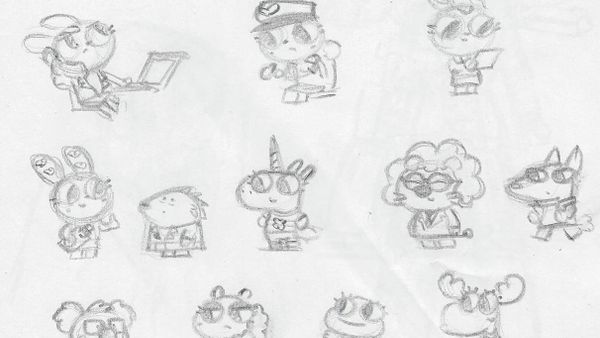
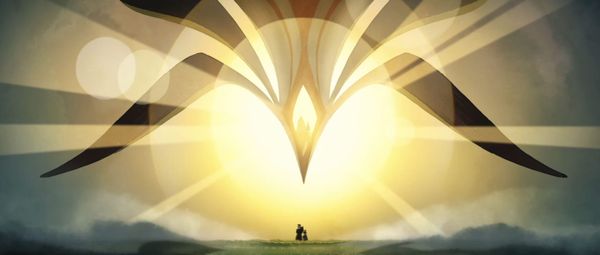
Almost all of the series 2 Fluffy Gardens episodes are based on a single core image – a huge field of flowers, cycling over a hill framed by a rainbow, a little boat sinking in a vast ocean. The same is true for Planet Cosmo. If you know the episodes, you’ll recognise some of the scenes in the sketches above, done before the stories were ever written. And it has value to young children as each episode becomes special, a completely unique event even in a format as structured as Planet Cosmo – the episode with the tiny pieces of ice floating in space, the episode with the raging red storm, the episode with the room full of glowing stars. Iconic visual moments unique to those episodes.

So how do you stay visual while writing, dealing with just words?

Well, my advice is: don’t deal with just words. Sketch and doodle as the story forms. Try to define some of those key moments in advance. Keep those drawings close. No matter how good or bad they are (nobody ever has to see those drawings), they will help you keep your visual picture. There are other ways too. You could trawl Google Images for locations similar to those you’re writing about. Print them out and place little cutout characters on them. For one feature script (keeping in mind that the more we write, the more the risk of losing visuals increases and a feature requires much more writing), I actually made myself a little playset, customising figures to match the characters in the story and building a basic set from cereal boxes.

You don’t have to go that far. But do whatever it takes to keep hold of those visual images and create those iconic moments. That way, you’re taking the best of both worlds – staying visual like those who create their stories through storyboards while embracing your passion for words and language.

Be wary of getting lost in the darkness. Stay visual.

Share and Enjoy:
  • Print
  • Facebook
  • Twitter

Tags: , , ,

Apr
3
Being okay with failure

I was speaking to a group of animation students a couple of weeks back, taking them through my career and how I got to do what I do. Moving from career leap to career leap, everything sounds pretty impressive, even to me and I lived it. But the truth is that I am only ever telling half the story. Actually, much less than half.

Because for every success there are several failures. Sometimes many failures. I don’t usually get to cover those in a short talk but they are important to acknowledge, hence this post.

I talk about my first job being an animation position on TVC’s Willows In Winter. But in reality, it’s the first job that means something in my career. My real first job was picking tomatoes, a job I was fired from. I tend to talk about Fluffy Gardens as my first self-created show. It is actually the first self-created show that I managed to get off the ground. It is not the first show I pitched. I move on to my next show, Planet Cosmo, pretty quickly and, in doing so, neglect to mention the few show concepts that came in between those two shows. And there are so many more little disappointments, unsuccessful pitches and out and out failures throughout my career.

‘Failure’ sounds like a very dramatic word, steeped in negativity. Failure can bring fear, sadness and, sometimes, can kill our motivation. Why try if it’s only going to end badly? But that is the exact opposite of what failure should do for us. We all need to be okay with failure. In fact, failure is really important. Here are some things to keep in mind about failure:

.

1 – Failure shows we have taken a risk. No advancements, career leaps or worthwhile successes will come without risk. It just doesn’t happen. If there is no risk of failure, we’re not really doing anything and certainly not trying anything new. So failure shows us we’re pushing ourselves. That’s a good thing. Push further.

2 – When creating, it is all part of a process. Ideas must be tried and tested, and then the results evaluated. We use that information to make the next creation better, more relevant. And nothing is ever wasted. Ideas from that project that didn’t make it will resurface in another project, often in a better form.

3 – In the end, the failures don’t count. This is so important to remind ourselves of because one of the things we all have to move past is our fear of failure. Failures can teach us but they don’t count in any negative way. The successes are what people will remember. When I talk about my career, I can talk for an hour and I’m still covering the successes. I don’t need to talk about the failures because people don’t care. Do you remember Steve Jobs for the failed Mac Cube or the success of the iPod? Which counts? All it takes is a single success to wipe away all failed ventures. Failures don’t count. So don’t fear them.

.

Not everything you do in your creative career is going to work out. It certainly won’t work out first time. If you’re really striving for better, for something important, failure is more than likely something you will face many times. Be okay with that. Embrace it. 

Share and Enjoy:
  • Print
  • Facebook
  • Twitter

Tags: , ,

Mar
27
Keeping up with the criticism

Would it be overly dramatic to compare working in children’s media to having a superpower? Well, when you create content for kids (be it shows, apps, marketing), it’s like being able to get into their houses, sometimes all at once. That is a power and, as Spider-Man says, with great power comes great responsibility.

Last weekend, the 8th international Consuming Kids Summit was held in Boston and Erin McNeill has posted some of the important takeaways from that here. Especially interesting to me is the comparison to the tobacco industry. Firstly, because it comes from Alex Bogusky, a modern day Don Draper who famously quit and said that it was immoral to advertise to children and, secondly, because who wants to wake up and realise they are today’s tobacco industry?

Another point well worth considering is the last one on the page, about responsibility. We can try and try to shift responsibility to the parents and, sure, parents are responsible for what they do. But, as a parent myself even being very aware of media messages, it is so hard to compete with the millions spent on marketing, whether targeting my children or not (my kids know all the TV heroes – Mickey Mouse, Peppa Pig, Cilit Bang’s Barry Scott).

Ultimately, we are responsible for what we create. We are responsible for the choices we give to parents and their children.

So where does that leave us as content creators, writers or producers?

We want children to watch our shows, don’t we? Of course we do. I know I do. So am I marketing to children? I guess with promos for my shows going out, I am. Would I love it if a Planet Cosmo toy hit the shelves and children wanted it? Yes, I would. I would be lying if I said I wouldn’t.

But that’s where that Spider-Man quote comes into play.

We can also do a lot of good with media. As I have said so often in this business – children are going to watch television. They are going to play games. They are going to play with toys. So we may as well make sure they’re getting good television, good games, good toys. Content that enriches, educates and, yes, entertains too. Content that works with parents.

Not everyone is going to agree on what good content is and so we need to draw our own lines. To do so, I think it’s important to keep up with things like the Consuming Kids Summit. Hearing the criticism is key. Listening. We may not always like what we hear but that means we need to listen even more. And then we can create better content or, if one day we find we don’t like where we are, choose not to make it at all.

For those possibly thinking this is all very idealistic, I’ll leave you with this thought – more and more parents are becoming aware about the media their children are consuming. Parents want their kids to do well. They want their children to grow up strong, confident, able to think independently, girls and boys alike. Good content for children is good business. You only have to look at Dora to see that – a show with educational content, positivity and a very strong active female main character. 

Share and Enjoy:
  • Print
  • Facebook
  • Twitter

Tags: , , , , , ,

Mar
20
Why specialise?

My special area of interest is preschool content and, more and more, I find myself introduced as an expert in that area. After a recent panel discussion on character at which I gave the preschool perspective, someone found me and asked why I specialise. Why preschool? Would I create content for older children or adults?

It just so happens that I have previously given talks warning of the dangers of specialising in such a fast-changing world so it’s something I have considered myself. Although, in those talks, what I am usually referring to is specialising in the technicalities, or the tools. Every year, new tools become available that render old skills redundant. The classical animation world I was trained for no longer exists, for example.

For me, it’s the difference between specialising in the medium or the genre. If I specialise, it is in the genre. The medium is open to change.

But why specialise at all?

For me, the core answer is actually quite simple – there is just so much to learn about effectively communicating with young children that it has to be something you are pretty dedicated to in order to do it well. Preschool is one of those areas that, from the outside, can look very simple and yet every new discovery opens up whole areas you realise you know nothing about. So am I an expert? Is anyone? The truth is that the real experts are preschool children themselves and, even with all I have done to date, they still have a LOT to teach me. Creating good content for a preschool audience requires study, it requires experience, it requires time.

Is the same true in creating content for audiences beyond preschool?

To an extent but, as your audience gets closer to adult age, you can start to rely on your own instincts as an adult and ask, what would I like? You can’t do that for a preschool audience. That question will often lead you astray.

That’s also one of the reasons I love making preschool content – it has a built-in fail-safe to prevent self-indulgence. You have to look beyond yourself and think of your audience. Even with all our other interests and creative outlets (and I have many of my own and, as it happens, have actually written and directed for audiences well above preschool age), creating for a preschool audience gives a wonderful sense of focus. Oh, I love to keep myself amused working for preschool but I know I can never do it at the expense of my young audience.

So why specialise? So that we can do better. So that we can put in the time and work to deliver content not just adequately, but do it really well. So that we can focus on our audience and give them something really good, something enriching.

And if all that isn’t enough of a reason, well, we get to make kids smile. 

Share and Enjoy:
  • Print
  • Facebook
  • Twitter

Tags: , , ,