May
15
Entertaining. Inspiring.

By now, you will have all seen Commander Chris Hadfield’s version of Bowie’s Space Oddity, recorded and filmed on the International Space Station. It is truly amazing. More than two hundred miles above the Earth, a man floated in a tin can, played his guitar and sent a song down here to those of us still on the planet.

My mind is still blown, not just by the amazing imagery, but the whole idea of this happening and what it means.

Go on, watch it again…

This world is changing so much. Things we take as normal could be gone in a couple of generations and things we can’t even imagine could be part of everyday life. Don’t believe me? Okay, yes, I too am disappointed we don’t yet have flying cars and robot butlers. But just consider the effect of 3D printers. Right now, for several grand, you can get a device that prints objects. Actual objects. Sure, they’re expensive and are limited in what they can do but what about in ten years? What if they’re in all our homes and capable of making much more than a pretty plastic model? Already the implications are becoming apparent with plans for 3D-printed guns hitting the Internet. More positively, we can print our own tools. Our own toys. Our own parts for almost anything.

What will that mean for industry? What value will manufacturing have? And if manufacturing has no value and plans are shared freely, what value has creation? Innovation? How will our economic models that served us well during industrial times stand up to change of that magnitude?

I don’t have all the answers. I am just using that one single device to illustrate the potential for society-altering change. Those of my age, of course, have seen such huge changes already. We are the generation who knows what it is like to live before the Internet and after it. I watch Mad Men and notice the lack of computers on the desks and I have to remind myself how we possibly got any work done without computers.

It is all changing.

So in a world where all is changing, what do we teach our children? What do I teach my girls? How about these – creativity, adaptability, problem solving. All good. Empathy, the will to do good. Great, I can see already we’re going to need each other as our planet changes. A love of learning, a search for knowledge, understanding, focus. Absolutely. Change can be influenced, steered, and a greater understanding of our world, our universe and just who we are can help us direct that change towards the positive, helping to make our lives better. Inspiration and aspiration, the belief that we can do amazing things and are capable of things thought previously impossible regardless of gender, race or social standing. Yes, yes, yes.

Commander Hadfield played a guitar in space and I think he has awed a whole generation. He entertained us. But he has done so much more – he has inspired us. The International Space Station is just the beginning of an amazing journey.

We can all play our part. I won’t get to space any time soon but I can inspire children to learn, to enjoy the wonders of our planetary neighbours. That’s why I created Planet Cosmo. It is entertainment first and foremost. Kids have to love the show, they have to laugh and smile and have to want to watch it. And they do. I have lovely mails from parents on how much their children enjoy it but those mails tell me the effect goes beyond the entertainment. My little show inspires – a love of learning, a new interest in space. I’m no Chris Hadfield but the reaction to the show tells me that our team at Geronimo Productions performed our space mission well. Our hard work paid off. And I have been so fortunate to work with such a dedicated team.

As I prepare to leave Geronimo at the end of this month, something that will be one of the biggest changes in my own life, I reflect back on what we have achieved and I can smile. But I’m also looking to the future, at what awesome gifts we can give the next generation to entertain them and inspire them, to enrich their lives both as children and adults.

It’s an adventure. Almost like packing my guitar and blasting off into space.

Well, not quite. But exciting nonetheless.

Thank you Commander Hadfield for entertaining us and inspiring us. And reminding me of two of the most important goals when creating content for children.


Share and Enjoy:
  • Print
  • Facebook
  • Twitter

Tags: , , , , , , ,

May
1
Write (and read) in character voices

There are huge challenges writing scripts for young children and I think many of them come from the simple reality of what we are doing – working with just words. Words can very quickly become abstract, lose meaning. As I went through in an earlier post, descriptions can fall away until you have just talking heads in a void and they all sound like the writer.

I think a good test of character is whether you would know who is speaking if the names were removed. Do the characters think and act differently? Do they speak differently?

They should.

We engage different parts of our brain when dealing with spoken word than we do when reading and writing. So just because something looks okay on the page doesn’t mean it’s going to sound okay when recorded. I write my stories out loud, saying each sentence over and over in different ways until it sounds right. I have done that since the very first Fluffy Gardens story and do it to this day. I’m not the only one. Ken Levine and David Isaacs (of Cheers/M.A.S.H. fame) dictate their scripts, working them out verbally as someone else types them out.

But saying them out loud in your voice may not be enough.

Writing in character voices is key to making those characters sound different, to get their personalities to come through in the dialogue. Because their voices will greatly affect the choice of words you settle on. If you’re just writing in your voice, you will pick words you will use. If you try words you would never use, they’ll sound awkward and weird. Put on a the voice as you write and you’ll very quickly find yourself putting sentences together differently.

For example, I recently rewatched an episode of Planet Cosmo and found myself laughing at Lifter’s choice of words – “Are you sure, sweetie? I can rustle up quite a breeze!” I thought, oh that’s good, I would never use the phrase “rustle up”. Then I had to remind myself that I wrote those words. But in a way, I guess Lifter said them. I just listened and wrote them down.

So it’s really important to write in character voices.

But I would take this a stage further and say that those of us reading scripts (script editors, producers, directors etc.) should try to read in character voices. You might not yet know exactly how they should sound but give it a go based on what you know of the characters. It will make those lines read very differently. For example, Cranky in Punky (written by the wonderful Andrew Brenner) has lines that can look very harsh and not age-appropriate on the page. But Cranky’s voice (Paul Tylak) gives her a comic quality that completely disarms the lines and makes them work beautifully. They become very funny. Similarly when I wrote Dad in Planet Cosmo, some of his lines looked rude, selfish and sometimes even mean. But say them in Dad’s voice and they become light and funny, losing their weight. How those words sound out loud in a character voice is what counts – that’s what children will hear.

It is always a challenge to make characters work and a greater challenge to make them work well. Working with the character voices is a way of helping their inner personalities and differences come out, and a great way of getting those words on (and off) the page.

Share and Enjoy:
  • Print
  • Facebook
  • Twitter

Tags: , , ,

Apr
24
Simplicity, drifting, relearning.

Many years ago, when I was just moving into children’s programming, I saw what was then Tell-Tale Productions (veterans Iain Lauchlan, Karl Woolley and Will Brenton) pitching a show called Where’s Boo? at the Cartoon Forum. They discussed the design and how their research showed that the simple shapes, clear colours and heavy lines made the character much easier to read for small children. Now sometimes people make outlandish claims at the Forum but this made sense to me and the (now ex) Tell-Tale guys know their stuff.

In the years that followed, I dug into research on how children perceive visual information and conducted quite a bit of my own testing on show concepts and designs. It was only then that I could truly appreciate how right they were. As adults, many of us tend towards complexity, the details, texture and polish. Many of these things have no relevance to preschool children and may even cause problems.

Young children need clarity. Visual simplicity.

I have written before about how I first found the Fluffy Gardens look – I drew the characters with a mouse. It prevented me from using some of the shapes and details that would be pleasing to me as an adult. I ended up with basic, crude drawings. Almost like those a child might do.

Children reacted so positively to these images and I found they were drawn in particular to the large eyes (hence them getting even larger in refining the look). The flat colours, the hard black lines on the characters and the simple easy-to-read expressions all contributed to it working for children, yet often far from what we look for as adults.

Since making Fluffy Gardens, different shows have had different needs. You can see, I’m sure, how Planet Cosmo is an evolution of the same ideas. Aiming at the higher end of preschool age range, Planet Cosmo needed to demonstrate the wonders of space. It needed to feel a little more beautiful, less crude. And yet still we have basic shapes, large eyes and flat colour on the characters. The balance took a long time to find and, throughout development and production, we had to remind ourselves of our purpose.

Because as we work, we tend to drift.

Often we drift towards old habits, sometimes we drift towards new ones. But we drift. This is across all aspects, not just design. It is why we so often play back old character samples when recording voice work for a show – even the actor who defined a voice can find themselves drifting away from it, just a little bit each recording. In classical animation, it is how characters might change when animating straight ahead, each drawing being just a little different from the previous one.

So it is important to reset.

Important to take us back to an earlier realisation and remind ourselves of what we learned. To relearn it. It is rarely enough to learn something just once.

For me, that means pulling out the very early Fluffy Gardens concepts, even more basic than the actual finished show. Appreciating the simplicity, the lack of details. And recognising that what I’m looking at is very different to what we often strive for or appreciate as adults. And that’s a good thing.

So, when working for young children, never fear simplicity. Keep in mind the drift, no matter what end of the craft you are in – writing, designing, directing, animating. Sometimes in our quest to get better, we can forget what is important to our audience.

Reset and relearn.

Share and Enjoy:
  • Print
  • Facebook
  • Twitter

Tags: , , , , , , ,

Apr
10
Writing visually

My path to writing stories for children has been a very visual one – animation, storyboarding, directing. Along the way, I have seen some wonderful scripts and have been very fortunate to work with some excellent writers. But I have also seen many submitted scripts that would be almost impossible to produce, some that make little sense and I have heard numerous complaints from animators about writers who just don’t think visually. Many on the animation side, for example, preach the value of forming the story through storyboards rather than words on a script.

Even with my visual background, when I moved into writing I embraced the words. The language. I love language and the flow and the rhythm that words can bring and I have done since long before I got into television. I don’t believe the value and power of words should ever be underestimated, even in preschool entertainment.

But early in my career, I was writing a script and something went wrong. Something was missing. I didn’t quite know what it was. It was while working out another basic story problem, remembering that a character could use a wrench left in an earlier description, that I realised what had happened.

That wrench had been there all along. But I didn’t see it. I didn’t see anything. I had lost the picture. I was now dealing in just words. Oh there were descriptions but I was no longer really seeing anything. It was a whole lot of spoken dialogue in darkness. The actions seemed abstract, lost in the darkness, and even the characters were nothing more than mouths to deliver dialogue.

I was not writing visually.

I have since seen that same thing happen in the scripts of others and even in books and what I have found is this –  the more words we write, the more risk there is of losing the picture. You can have great dialogue and really play with those words and that’s great but you have to have a complete visual picture. More than that, you have an opportunity to create something wonderful with those visuals, an opportunity that should not be wasted. Think of some of the defining imagery in movies – the long spacecraft Discovery in 2001, getting the yellow bus moving in Little Miss Sunshine, pushing into the wind in Babel. Imagery so iconic, it often feels the rest of the movie is built around it. It is no surprise so many of those moments end up on the posters.

Does it happen in preschool? Sometimes. It does now when I write it.

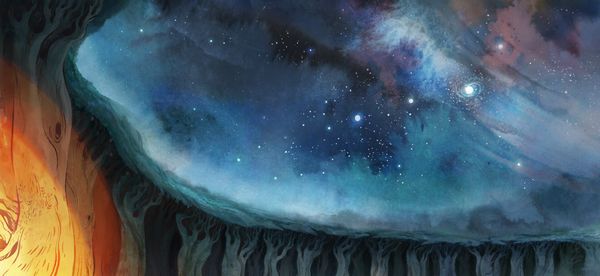
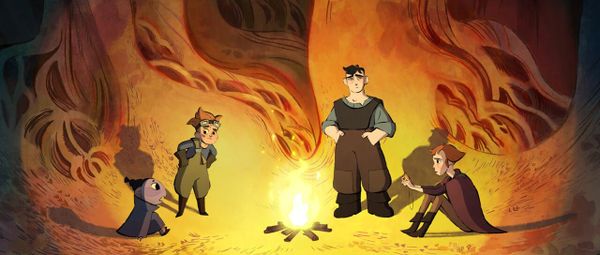
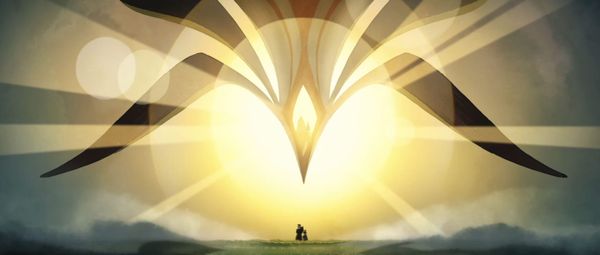
Almost all of the series 2 Fluffy Gardens episodes are based on a single core image – a huge field of flowers, cycling over a hill framed by a rainbow, a little boat sinking in a vast ocean. The same is true for Planet Cosmo. If you know the episodes, you’ll recognise some of the scenes in the sketches above, done before the stories were ever written. And it has value to young children as each episode becomes special, a completely unique event even in a format as structured as Planet Cosmo – the episode with the tiny pieces of ice floating in space, the episode with the raging red storm, the episode with the room full of glowing stars. Iconic visual moments unique to those episodes.

So how do you stay visual while writing, dealing with just words?

Well, my advice is: don’t deal with just words. Sketch and doodle as the story forms. Try to define some of those key moments in advance. Keep those drawings close. No matter how good or bad they are (nobody ever has to see those drawings), they will help you keep your visual picture. There are other ways too. You could trawl Google Images for locations similar to those you’re writing about. Print them out and place little cutout characters on them. For one feature script (keeping in mind that the more we write, the more the risk of losing visuals increases and a feature requires much more writing), I actually made myself a little playset, customising figures to match the characters in the story and building a basic set from cereal boxes.

You don’t have to go that far. But do whatever it takes to keep hold of those visual images and create those iconic moments. That way, you’re taking the best of both worlds – staying visual like those who create their stories through storyboards while embracing your passion for words and language.

Be wary of getting lost in the darkness. Stay visual.

Share and Enjoy:
  • Print
  • Facebook
  • Twitter

Tags: , , ,

Apr
3
Being okay with failure

I was speaking to a group of animation students a couple of weeks back, taking them through my career and how I got to do what I do. Moving from career leap to career leap, everything sounds pretty impressive, even to me and I lived it. But the truth is that I am only ever telling half the story. Actually, much less than half.

Because for every success there are several failures. Sometimes many failures. I don’t usually get to cover those in a short talk but they are important to acknowledge, hence this post.

I talk about my first job being an animation position on TVC’s Willows In Winter. But in reality, it’s the first job that means something in my career. My real first job was picking tomatoes, a job I was fired from. I tend to talk about Fluffy Gardens as my first self-created show. It is actually the first self-created show that I managed to get off the ground. It is not the first show I pitched. I move on to my next show, Planet Cosmo, pretty quickly and, in doing so, neglect to mention the few show concepts that came in between those two shows. And there are so many more little disappointments, unsuccessful pitches and out and out failures throughout my career.

‘Failure’ sounds like a very dramatic word, steeped in negativity. Failure can bring fear, sadness and, sometimes, can kill our motivation. Why try if it’s only going to end badly? But that is the exact opposite of what failure should do for us. We all need to be okay with failure. In fact, failure is really important. Here are some things to keep in mind about failure:

.

1 – Failure shows we have taken a risk. No advancements, career leaps or worthwhile successes will come without risk. It just doesn’t happen. If there is no risk of failure, we’re not really doing anything and certainly not trying anything new. So failure shows us we’re pushing ourselves. That’s a good thing. Push further.

2 – When creating, it is all part of a process. Ideas must be tried and tested, and then the results evaluated. We use that information to make the next creation better, more relevant. And nothing is ever wasted. Ideas from that project that didn’t make it will resurface in another project, often in a better form.

3 – In the end, the failures don’t count. This is so important to remind ourselves of because one of the things we all have to move past is our fear of failure. Failures can teach us but they don’t count in any negative way. The successes are what people will remember. When I talk about my career, I can talk for an hour and I’m still covering the successes. I don’t need to talk about the failures because people don’t care. Do you remember Steve Jobs for the failed Mac Cube or the success of the iPod? Which counts? All it takes is a single success to wipe away all failed ventures. Failures don’t count. So don’t fear them.

.

Not everything you do in your creative career is going to work out. It certainly won’t work out first time. If you’re really striving for better, for something important, failure is more than likely something you will face many times. Be okay with that. Embrace it. 

Share and Enjoy:
  • Print
  • Facebook
  • Twitter

Tags: , ,